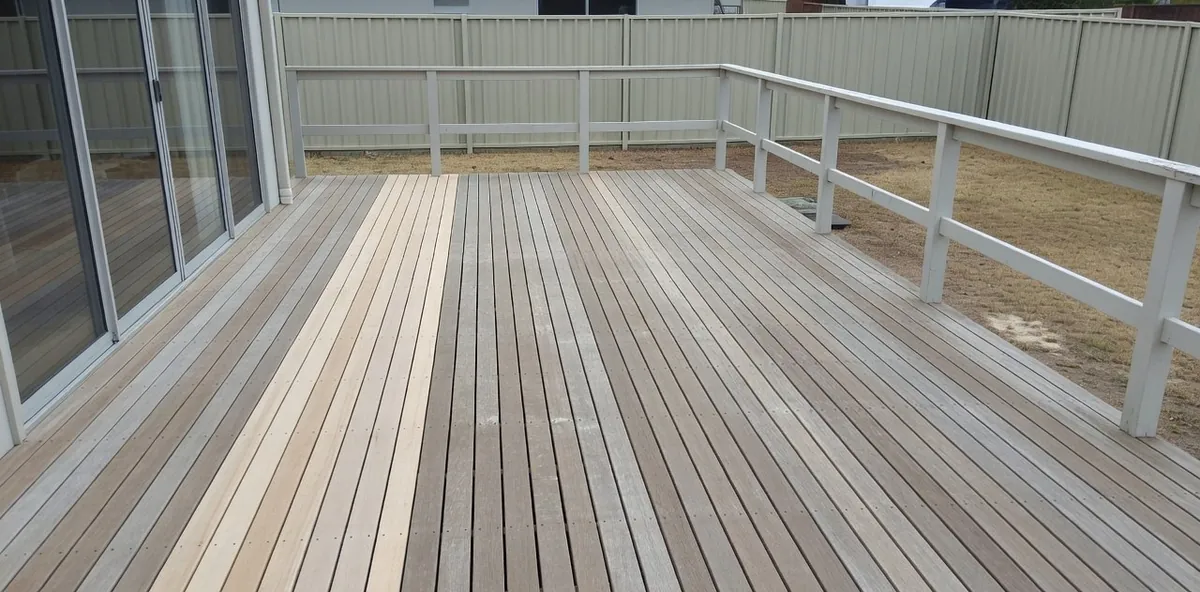
A deck is sanded with the same machines as a floor and finished with completely different products. Getting that second half wrong is why decks fail in two summers.
No obligation. Takes 30 seconds.
Floor Sanding and Polishing Brisbane connects Brisbane and greater Brisbane property owners with qualified, licensed local floor sanders for decking. Tell us the rough floor area and what condition the boards are in and we'll match it to a licensed contractor covering your suburb. Firm per-square-metre price after an inspection.
An indoor floor is sealed. A film sits on top of the timber and keeps water out, and because the room is climate-controlled that film lasts years. A deck moves with every rain and every hot day, and it takes direct ultraviolet light. A hard film on a deck cracks, then water gets under the crack, and the finish lifts in sheets. That is why decking oil penetrates rather than coats.
Cleaning first, because a grey weathered surface is degraded timber and salts, not dirt. Then sanding, usually to a coarser finish than an indoor floor — a deck sanded too smooth sheds oil and becomes slippery when wet. Any popped nails or screws go below the surface before the abrasive reaches them. Then two or three coats of oil, wet on wet, on a dry forecast.
Our summer is the worst possible time to coat a deck and the time most people want it done. Oil needs the timber dry through its thickness, not just on the surface, and a deck that was rained on two days ago is not dry. A north or west facing deck here takes far more ultraviolet than the same deck in Melbourne, so re-oiling intervals are shorter — expect twelve to eighteen months, not three years.
Rot, and boards that have cupped badly enough to hold water. Sanding a cupped deck board flattens the top and leaves the board thinner over the fixings, which brings the next failure forward. Any board that is soft under a screwdriver should be replaced before the deck is sanded, not after.
Brisbane.
Where this job typically sits. Access is usually a bigger cost driver than size.
| Job | Indicative price | What moves it |
|---|---|---|
| Sand and polish, per square metre | $35 – $60 /m² | The standard way this is quoted. Covers sanding plus coats. |
| Typical 3-bedroom house (~110m²) | $3,800 – $6,500 | Whole floor, sanded and finished. Condition drives the range. |
| Single room (~15m²) | $700 – $1,200 | Small jobs carry proportionally more setup. |
| Carpet lift and staple removal | $8 – $15 /m² | Often quoted separately. Staples and tack strips take real time. |
| Board replacement | $90 – $200 per board | Matching an old profile costs more than the timber does. |
| Extra coat of finish | $8 – $14 /m² | Three coats is standard; a high-traffic hallway may want four. |
| Stain or colour change | $10 – $20 /m² | On top of sanding. Sample it on your actual timber first. |
| Parquetry restoration | $70 – $120 /m² | Slower and more skilled than strip flooring. |
| Recoat only (no full sand) | $18 – $30 /m² | Where the finish is worn but the timber is sound. Far cheaper. |
| Moisture assessment | $150 – $300 | Worth it on any floor that has been wet or looks cupped. |
Prices are indicative only and usually quoted per square metre. What a floor costs depends on its condition, the timber, how many coats it needs and whether boards have to be replaced. You get a firm price after an inspection.

The core job — taking a tired timber floor back to bare wood.
Read more →
The finish itself — water-based or solvent, and how many coats.
Read more →
Lifting carpet to find — and rescue — the original boards underneath.
Read more →
Replacing damaged, cut or borer-affected boards before sanding.
Read more →Tell us the suburb and the floor area and we'll get it to the right person.
Call 0468 158 248